

France is the country with the most Nobel Prize winners in literature: 15 Nobel laureates, all of them men. This year, the Nobel Prize in Literature was awarded for the first time to a French female author, Annie Ernaux.
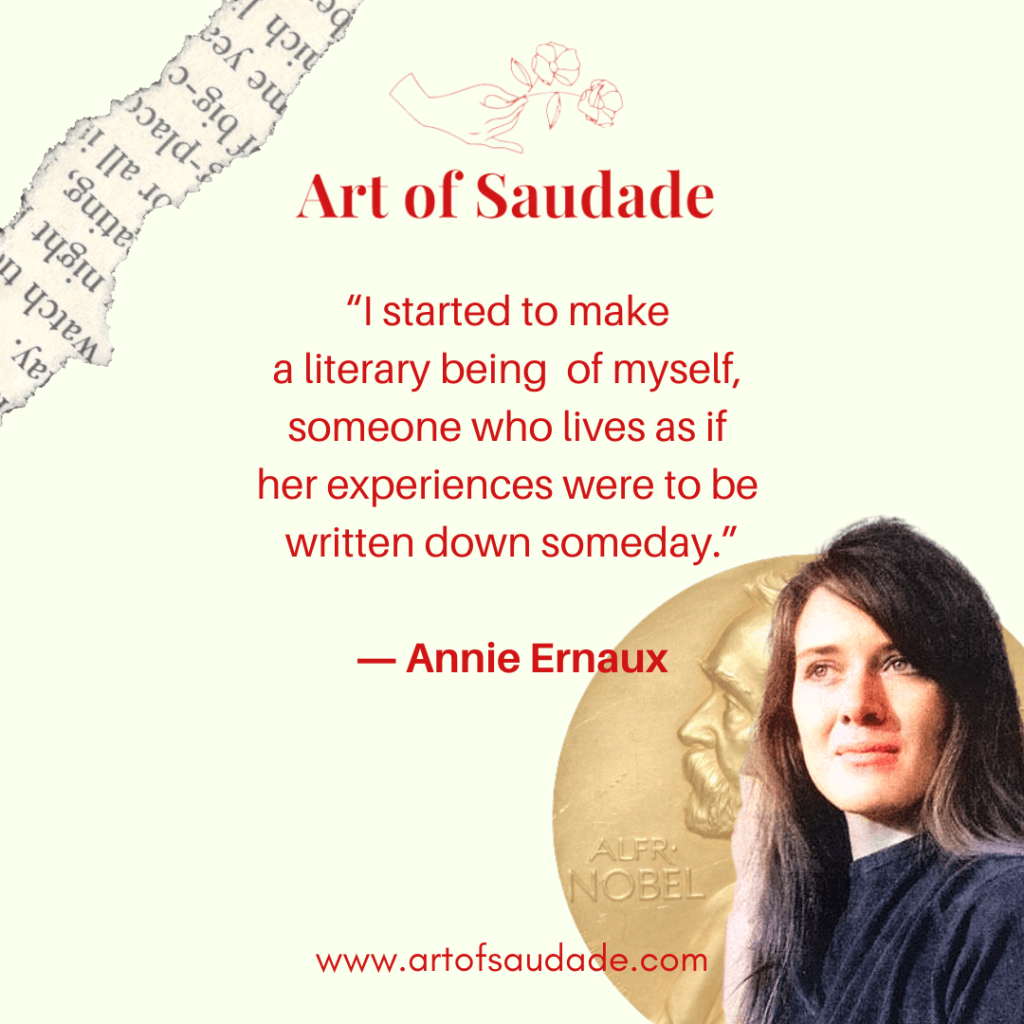
Annie was born in the middle of World War II, in a small town in the Normandy region. She portrayed the ordinary life of her working-class family, “uncovering the roots, estrangements and collective restraints of personal memory”.
In 1974, she started her literary career with the autobiography “Cleaned Out”. Ten years later, she won the prestigious Renaudot Prize for another autobiographical novel “La Place”, depicting the Kafkaesque relationship with her family.
“Maybe the true purpose of my life is for my body, my sensations and my thoughts to become writing, in other words, something intelligible and universal, causing my existence to merge into the lives and heads of other people.”
Annie Ernaux, Happening
La Place – between paternal love and social identity

This book opens with a memory from the narrator’s adolescence, aiming to reveal the inner life of her father and all the conflicts that result from it. After sketching a physical and social portrait, Annie Ernaux dives into her most intimate memories to reveal all of her father’s fears and obsessions, as well as all of his prejudices related to his social background.
However, amidst so much fear and uncertainty, we see the timid emergence of a bit of fatherly love. Through indirect speech, the writer allows herself to observe and judge scenes from her own life.
“Sometimes I wonder if the purpose of my writing is to find out whether other people have done or felt the same things or, if not, for them to consider experiencing such things as normal. Maybe I would also like them to live out these very emotions in turn, forgetting that they had once read about them somewhere.”
Annie Ernaux, Simple Passion
This story is a beautiful illustration of what René Girard called a mimetic desire – the tendency to compare oneself to others, to do as others do to satisfy the need to belong and be recognized in society. Although the narrator shows us from the beginning her open-mindedness, we can see that she is strongly influenced by her father’s reflections, especially in a period of a fragile identity such as adolescence.
The author then moves on to the father’s fear that his daughter, an intellectual girl growing up in a working-class family, “would be seen as a lazy person”.
We see the paradox of the father: the constant effort to get out of the so-called middle class (becoming a small shopkeeper) and the fear of being seen as an elitist.
When describing her father in La Place, Annie says: “When I read Proust or Mauriac, I don’t think they evoke the time when my father was a child. His setting was the Middle Ages.
Indeed, the text leads us to believe that her father has already mapped out her destiny, imagined her future, and created expectations that his daughter must meet. However, despite his criticisms and disagreements, we see throughout the text that he is resigned to his daughter’s choices. The father’s reproaches have only one objective: to see his daughter happy. And yet his idea of happiness is determined by his background – to earn an honest living but above all to create a good reputation in society and thus find his place.
Her flat writing (a text that lacks action or emotion) serves the purpose – she tells the story in a nuanced way and it is up to the reader to interpret it. As for the daughter’s love, it is highlighted by all her attempts to break the silence between her and her father, which ends in the genesis of the novel: “Maybe I’m writing because we had nothing more to say to each other.”
When reading Annie’s La Place, we enter the world of Franz Kafka who also had a tendency to give simple initials to characters instead of full names. However, Annie Ernaux will find a way to fill the void that exists between her and her father, even after his death. It is the choice to dedicate a novel to him, in the same way that Kafka wrote a Letter to his father: “I was continually in disgrace; either I obeyed your orders, and that was a disgrace, for they applied, after all, only to me; or I was defiant, and that was a disgrace too, for how could I presume to defy you; or I could not obey because I did not, for instance, have your strength, your appetite, your skill, although you expected it of me as a matter of course; this was the greatest disgrace of all.”
Unfortunately, these two works were never delivered to their recipients. Nevertheless, the father figure marks both authors and their vision of the world: “… it is, after all, not necessary to fly right into the middle of the sun, but it is necessary to crawl to a clean little spot on Earth where the sun sometimes shines and one can warm oneself a little.” (Franz Kafka – Letter to His Father, 1919).
The Bourdieusian theory
The portrait the narrator paints is not only aesthetic but also sociological. With the image of her father, whose life is essentially “subject to necessity”, she presents the theory of habitus, according to which everything we are is determined by our social structure.
Annie Ernaux takes into account the sociological aspect of the human being. Through her flat writing, she emphasizes that this is not an autobiography as such since the focus is not on her and her personality. On the other hand, strongly influenced by sociological and psychological theories, her work becomes a testimony of a real social phenomenon.
“When I write I do not have the impression of looking inside me, I look inside a memory.”
Annie Ernaux
When writing about her life, Annie Ernaux evokes the life of millions. As Clarice Lispector would say, when saving one’s life through literature, we save the lives of millions.
I write as if to save somebody’s life. Probably my own. Life is a kind of madness that death makes. Long live the dead because we live in them.
Clarice Lispector
Did you appreciate this post? Follow @art_of_saudade on Instagram for similar content!
Want to support the blog?
Buy me a coffee ☕
Make a monthly donation
Make a yearly donation
Choose an amount
Or enter a custom amount
Your contribution is appreciated.
Your contribution is appreciated.
Your contribution is appreciated.

