
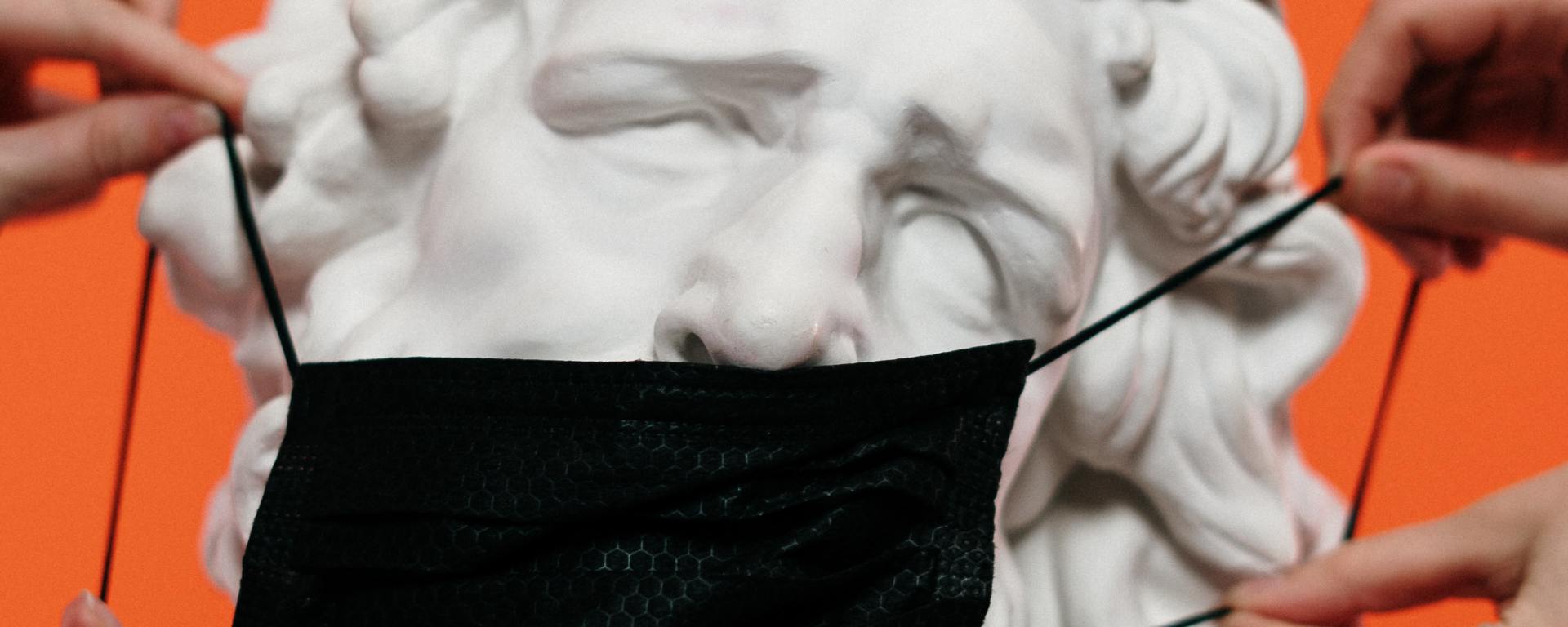
Lockdown, transmission, and quarantine are some of the words that have been part of our daily vocabulary for the past two years. These same words can be found in Camus’ philosophical novel The Plague. Published only two years after the Second World War, many literary critics believe that the plague symbolizes the battle against Nazism. However, digging into the book, it is easy to conclude that Camus truly referred to a health crisis threatening humanity.
Giving a snapshot of the Algerian city of Oran, the Algerian-born French philosopher Albert Camus tells us that “perhaps the easiest way of making a town’s acquaintance is to ascertain how the people in it work, how they love, and how they die.”
The image of Oran is dystopian. It is “a city without pigeons, trees, and gardens, where you don’t see wings flapping or leaves rustling. The change of seasons can only be read in the sky. Spring is announced only by the air quality or by the baskets of flowers that small vendors bring from the suburbs; it is a spring sold on the markets. […] The beautiful days come only in winter.”
In The Plague, Camus tells the story of the city being hit by a mortal virus spread by rats and sparing no one. Camus tries to give the reader an idea of what could be the cause of such an epidemic, linking the appearance of diseases and wars to our disconnection from nature.
“Without doubt, nothing is more natural today than to see people working from morning to night and then choosing to waste the time they have left to live on cards, coffee, and gossip.“
At the beginning of the plague, we can spot several striking similarities to the current pandemic. For instance, it takes people some time to understand or acknowledge that it is a real epidemic, and they believe that it would last for a short time. Interestingly enough, Camus makes the same observation about wars:
“There have been many plagues in the world as there have been wars, yet plagues and wars always find people equally unprepared. […] When a war breaks out people say: ‘It won’t last, it’s too stupid.’ And war is certainly too stupid, but that doesn’t prevent it from lasting. Stupidity always carries doggedly on, as people would notice if they were not always thinking about themselves.”
The second conclusion is that instead of looking for the cause, we should try to focus on the solution. The whole story (reminder: written in 1947) sounds like some bad news that we heard recently: a shortage of hospital beds, borders and businesses getting closed, social relations being changed, and one often repeated phrase: “let’s hope that it won’t last too long”.
The pandemic changed our lives without any doubt. It changed society and the way we perceive it. Human relations are no longer as they used to be. Even though things seem to be going back to “normal”, we can still feel the changes in our daily lives.
“For there is no denying that the plague had gradually killed off in all of us the faculty not of love only but even of friendship. Naturally enough, since love asks something of the future, and nothing was left but a series of present moments.”
The other day my friends and I were discussing the culture of “la bise” in France, which means giving two or three kisses to greet someone (it depends on the region, in some French cities the number of kisses is four or more). Now, even though this custom hasn’t died, it isn’t as common to give kisses to random people you meet as it used to be before the pandemic.
Will the fist bump replace la bise? That is the question.
“Our fellow citizens were not more guilty than others, they forgot to be modest, that’s all, and they thought that everything was still possible for them, which supposed that the plagues were impossible. They continued to do business, they planned trips and they had opinions. How would they have thought of the plague that suppressed the future, travel, and discussion? They thought they were free and no one will ever be free as long as there are plagues.”
A loveless world is a dead world
Difficult times often bring good ideas. Plagues, as Camus puts it, remind us that life is unpredictable, the future’s uncertain, and the end is always near (that last phrase seems to be repeated by Jim Morrison).
“Thus each of us had to be content to live only for the day, alone under the vast indifference of the sky.”
Albert Camus’ dystopian novel has a happy ending: the epidemic does end. Although Camus is often believed to be highly pessimistic, it’s interesting that he loved ending his stories with a good conclusion. This time, he didn’t make an exception.
“They knew now that if there is one thing one can always yearn for, and sometimes attain, it is human love.”
So, did Camus really predict the pandemic in The Plague? He did, and his understanding of the pandemic is beyond a simple health crisis. It is a threatening humanitarian and moral crisis that emerges from it.
“Each of us has the plague within him; no one, no one on earth is free from it. And I know, too, that we must keep endless watch on ourselves lest in a careless moment we breathe in someone’s face and fasten the infection on him. What’s natural is the microbe. All the rest – health, integrity, purity (if you like) – is a product of the human will, of a vigilance that must never falter.”
Did you like this post?
Buy me a cookie 🍪
Make a monthly donation
Make a yearly donation
Choose an amount
Or enter a custom amount
Your contribution is appreciated.
Your contribution is appreciated.
Your contribution is appreciated.
DonateDonate monthlyDonate yearly Art of Saudade