
March 23, 1900: a boy is born into an Orthodox Jewish family in Frankfurt, Germany. 22 years later and a few years before the Nazi ideology started to rise in Germany, he completed his Ph.D. with a dissertation named “On Jewish Law”.
If your teachers are Alfred Weber (brother of the famous sociologist Max Weber), the philosophers Karl Jaspers and Heinrich Rickert, there’s no doubt that you’re expected to do something great.
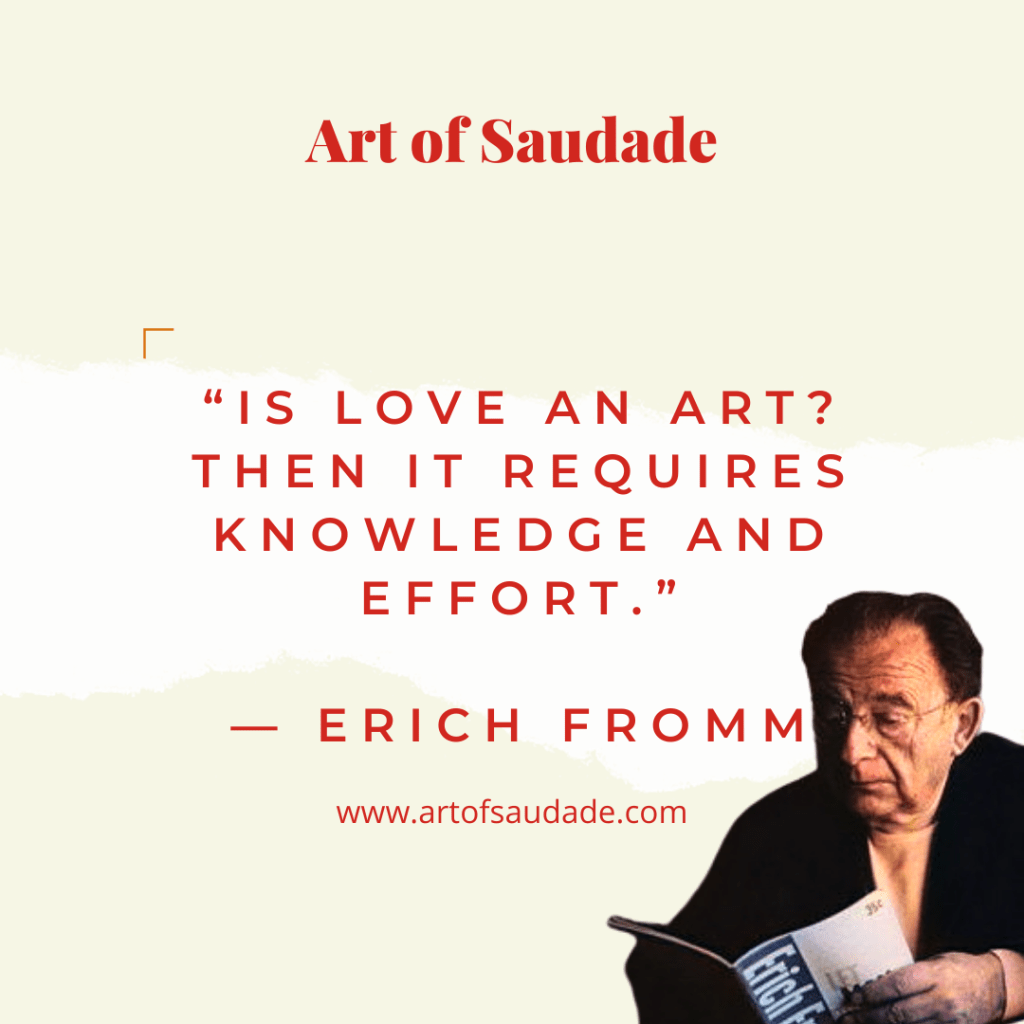
This boy is Erich Fromm, one of the greatest philosophers of all time. In 1934, he fled Nazi Germany and dedicated his life to philosophy, psychology, and sociology.
The author of The Art of Loving had all the rights to either lament his fate or find a reason to keep going. He chose to persevere for a noble reason – Love.
“Love is the only sane and satisfactory answer to the problem of human existence.”
Fromm managed to define one of the most undefinable concepts:
“Love is a decision, it is a judgment, it is a promise. If love were only a feeling, there would be no basis for the promise to love each other forever. A feeling comes and it may go. How can I judge that it will stay forever when my act does not involve judgment and decision […] Love isn’t something natural. Rather, it requires discipline, concentration, patience, faith, and overcoming narcissism. It isn’t a feeling, it is a practice.”
– Erich Fromm, The Art of Loving
When Erich Fromm talks about love, he refers to universal love and this is what he means:
“Love is not primarily a relationship to a specific person; it is an attitude, an orientation of character which determines the relatedness of a person to the world as a whole, not toward one “object” of love. If a person loves only one other person and is indifferent to the rest of his fellow men, his love is not love but a symbiotic attachment, or an enlarged egotism. Yet, most people believe that love is constituted by the object, not by the faculty.”
– Erich Fromm, The Art of Loving
He believed that there are many stages of love, starting from the rudimentary and least sophisticated “infantile” love to a higher form of “mature” love:
“Infantile love follows the principle: “I love because I am loved.”
Mature love follows the principle: “I am loved because I love.”
Immature love says: “I love you because I need you.”
Mature love says: “I need you because I love you.”
– Erich Fromm, The Art of Loving
Fromm affirmed that there could be no love without generosity, empathy, and compassion. True love is what you give, and not what you receive. More than 50 years ago, he warned humanity about the potential alienation from each other and from nature by reversing these values: modern men need to receive more than to give.
“Love is an activity, not a passive affect; it is a “standing in,” not a “falling for.” In the most general way, the active character of love can be described by stating that love is primarily giving, not receiving.”
– Erich Fromm, The Art of Loving
 Art of Saudade