
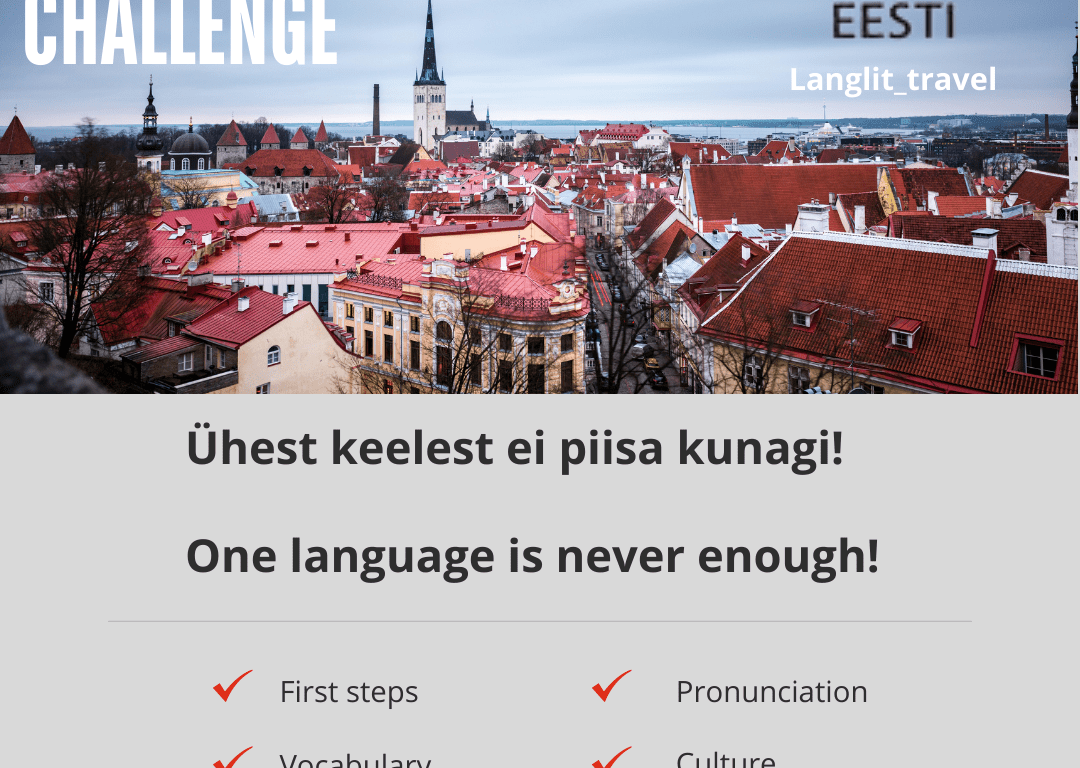
Ühest keelest ei piisa kunagi! – One language is never enough!
First impressions of the Estonian language
Trying to get familiar with a new language in only one month is definitely an interesting challenge for language enthusiasts, however it is not as easy as it seems. The idea was to start learning a language from scratch and see how much we can learn in a month. Even though we’re all busy with our lives, studies and work, dedicating at least an hour of our day (or a week) is the slightest effort we can make.
Estonian: first steps
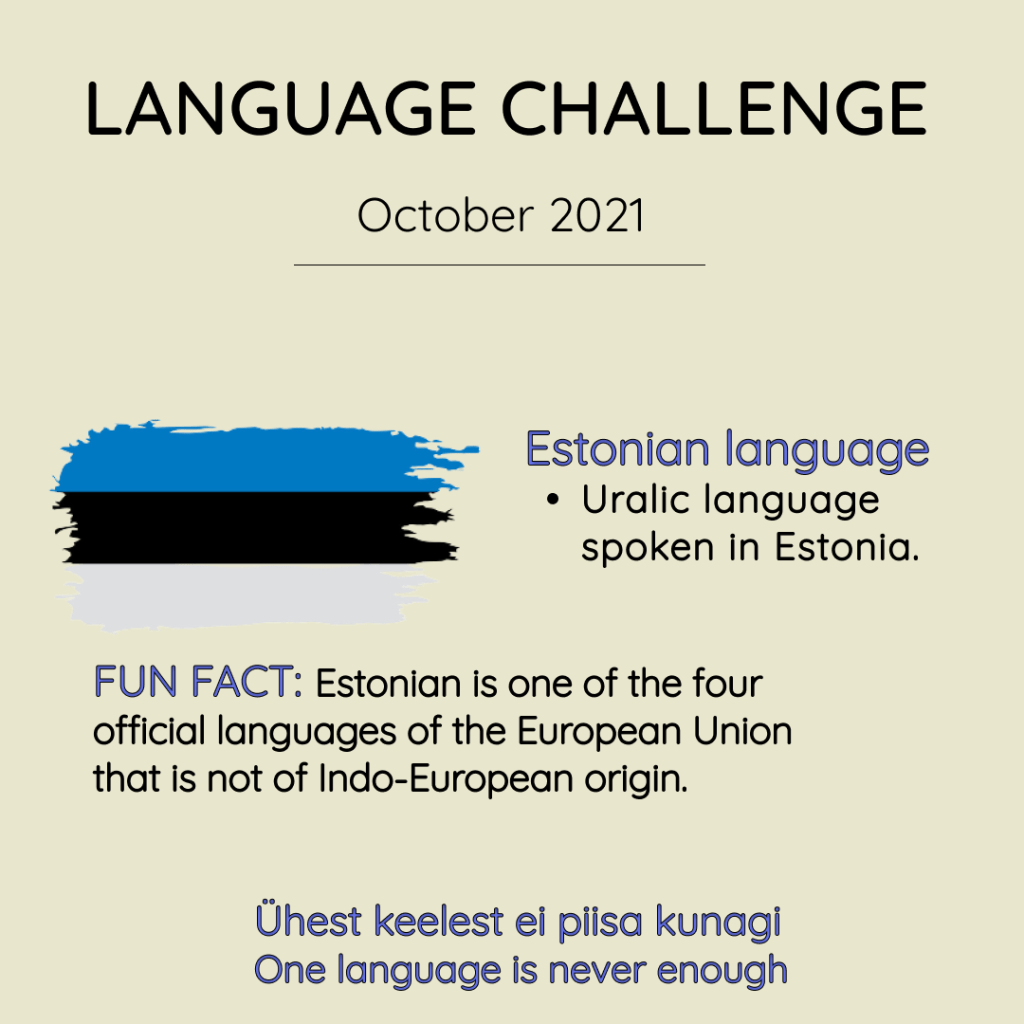
Estonian is a Uralic language and it is considered as one of the hardest languages in Europe. The fact that Estonian has fourteen grammatical cases (German, which is also a hard language, has only 4), can be quite discouraging. However, as a part of the monthly language challenge, I never believed I could get to the level of acquiring complex grammar structures, so I decided to start by learning the essential expressions (for dummies!).
Vocabulary:
This list of essential words and expressions can be applied to any language, and it is the very basics of the language that needs to be acquired in our first week of language study.
(Check out my list of the very basic expressions you need to know in Estonian in my next article).
Pronunciation:
In my opinion, Estonian pronunciation is unexpectedly easy! Of course, this depends on the languages you already speak and how close they are phonetically to your target language. As a Slavic and Latin speaker, I can say that Estonian can be one of the easiest languages to pronounce. The only sounds that may seem difficult are perhaps ä, ö, ü, and õ, but again, this depends as well on the languages you speak and how familiar you are with these sounds. To learn the pronunciation, I tried listening to Estonian music and podcasts as often as I could.
Context:
Another important aspect in your language learning journey is not merely to memorize a list of words, but to learn how and in what context you can use them. For instance, if we take the Estonian word you may first learn (“tere” which means “hello”), you must know that it should be pronounced almost “without emotions”. This can be especially difficult for Latin speakers, for example Brazilians who would pronounce it with more emotion as they would say “Oi” in their native language. This aspect has more to do with mentality and culture than language, but it still makes part of the language learning process.
Influence from other languages:
- Finnish
Even though I don’t speak Finnish, I know a few expressions, which is enough to realize there is some similarity between these two languages.
On the other hand, there are false friends that can mislead you, such as: Aitäh (“Thank you”) in Estonian and “Ai täh?” (“Wait, what?”) in Finnish.
Fun fact: Estonians happen to understand more Finnish than Finnish people are able to understand Estonian. This is a phenomenon that happens in other cultures as well, such as Portuguese people being generally able to understand Spanish, whereas Spanish people have more difficulties understanding Portuguese.
Results:
All in all, I can say that my expectations were not disappointed. I must confess that even though I didn’t put enough effort into studying, I still acquired the basics of the language and got motivated to continue. Whether I’ll continue learning it extensively or not, I don’t know, but one thing is sure: it was a real challenge and I absolutely loved it.
The good thing about languages is that we can always get back to them.
One month ago, I had no idea how Estonian sounded, how similar it was to other languages or how complex its grammar was. Now, I can say that it is one of the languages I will certainly get back to.
What next?
Check out our new monthly challenge – November 2021 in my next post.
 Art of Saudade