
The Little Prince is my little Bible that I carry with me everywhere I go. I remember I got my first copy on April Fool’s day when the world traditionally celebrates laughter and happiness. I don’t believe in coincidences. This book will teach you to laugh… in case you forgot, just like grown-ups forget they were once children. After all, the little prince is still laughing out there and the stars laugh along with him. Here are the 5 most important lessons I learned from the little man with golden hair who laughs and refuses to answer questions:
1. Never stop being a child
The world started being a dirty place when children became grown-ups. Don’t get me wrong, I’m not against growing up. I’m talking about reconsidering the way we grow up and suddenly start pretending what we’re not. Is there a way we can remember who we were before the world told us who we should be? Maybe we can start by opening our eyes and seeing a boa constrictor digesting an elephant instead of a hat.
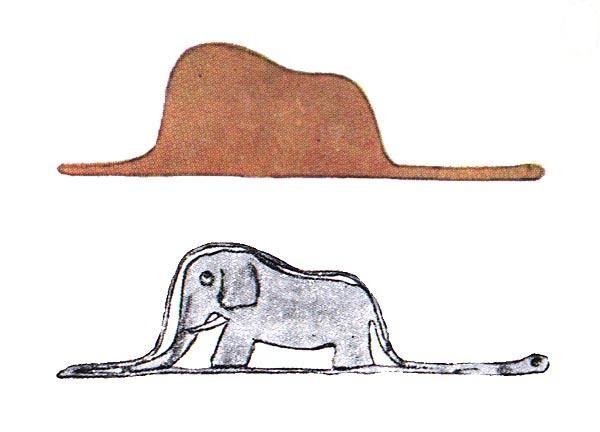
But they answered: “Frighten? Why should any one be frightened by a hat?” My drawing was not a picture of a hat. It was a picture of a boa constrictor digesting an elephant. But since the grown−ups were not able to understand it, I
made another drawing: I drew the inside of the boa constrictor, so that the grown−ups could see it clearly. They always need to have things explained.
2. The grown-up world is ridiculous
The adults in The Little Prince are portrayed as dull and egocentric creatures. The little prince’s first encounter with a grown-up is on an asteroid inhabited by a king. This scene represents excessive human vanity, “blue-blooded” people’s meaningless values, as well as the unexplainable need to rule and be obeyed. After the little prince gets bored and wants to leave, the king’s reaction shows the human pathetic fear of ending up alone and making promises without being able to fulfill them. In the ruler’s case, the ultimate goal is praise and glory.
The more the little prince gets to meet different grown-ups, the more he realizes how odd they are. From the narcissist to the tippler who drinks to forget he’s a tippler, the author offers us a canvas of bizarre characters that make the protagonist come to the crystal clear conclusion: “The grown−ups are certainly very, very odd”.
3. Happiness lies in simplicity
In a world greedy for arguments and scientific proofs, a French writer and aviation pioneer writes a novella dedicated to his friend Léon Werth (when he was a little boy!) and makes us believe that the proof that the little prince existed is that he was charming, that he laughed, and that he was looking for a sheep. If anybody wants a sheep, that is proof that he exists. The readers who accepted Peter Pan’s warning “Growing up is a trap” will trust Saint-Exupéry too. Being a child means being carefree, ignoring everything related to “bridge, and golf, and politics, and neckties”. All in all, the little prince concludes, grown-ups are like that. One must not hold it against them. But certainly, for us who understand life, figures are a matter of indifference.
“If you were to say to the grown−ups: “I saw a beautiful house made of rosy brick, with geraniums in the windows and doves on the roof,” they would not be able to get any idea of that house at all. You would have to say to them: “I saw a house that cost $20,000.” Then they would exclaim: “Oh, what a pretty house that is!”
Antoine de Saint-Exupéry, The little prince, p. 12
4. It is only with the heart that one can see rightly. What is essential is invisible to the eye.
The Little Prince is above all a love story. The author reminds us of a forgotten truth: only the heart can be true love’s temple. The Upanishads call the heart “the abode of Brahman” and the 13th-century Persian poet Rumi would say “Only from the heart can you touch the sky”. Who could tell that a hundred-page “children’s book” would hide ancient, yet everlasting secrets?
5. Love the way the little prince loved his rose
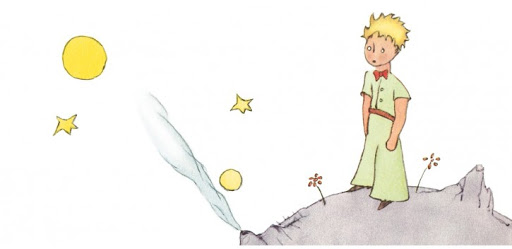
The little prince loved the rose without expecting anything in return. He loved her despite her vanity and her dramas, he ignored her flaws, and most importantly, he knew that she was one in a million. Love as pure as this never ends up being what one famous rabbi would call “fish love”. He says:
Let me tell you a story about the Rabbi of Kursk. He came across a young man who was clearly enjoying a dish of fish that he was eating, and he said: ‘Young man, why are you eating that fish? And the young man says ‘because I love fish!’ He says: ‘Oh you love the fish, that’s why you took it out of the water and killed it and boiled it.’ He said ‘don’t tell me you love the fish; you love yourself, and because the fish tastes good to you, therefore you took it out of the water and killed it and boiled it.’ So much of what is love is fish-love.
Rabbi Abraham Twerski

 Art of Saudade