

Mario Vargas Llosa, the Peruvian maestro of storytelling and Nobel laureate, takes readers on an enchanting journey that spans continents and transcends time. From the vibrant streets of Florence to the mystical heart of Peru’s forests, ‘The Storyteller‘ unfolds as a captivating narrative tapestry, revealing the rich cultural mosaic that defines Llosa’s literary masterpiece.
The adventure kicks off in Florence, where our protagonist seeks a temporary escape from his Peruvian roots. Little does he know that a random encounter with a photograph in an Italian museum would become a portal, pulling him back into the embrace of Peru and its mesmerizing Machiguengas people.
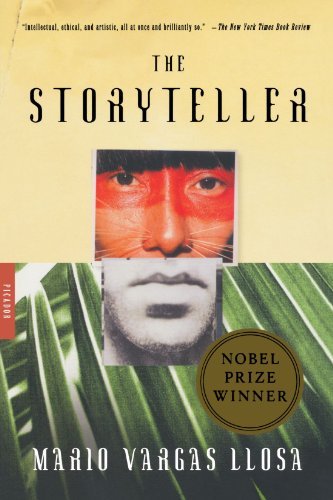
As the emotional rollercoaster triggered by the Machiguengas’ photograph unfolds, Llosa guides us to Lima. Here, memories of his student days mingle with the fervor of Mascarille, an anthropologist grappling with the unintended consequences of his discipline on indigenous cultures. Llosa’s narrative becomes a clash of philosophies, blending Western ideals with the ancient wisdom of the Machiguengas.
The narrative then sweeps us to Quillabamba, revealing ethnological treasures that illuminate the daily lives and beliefs of the Machiguengas. ‘The Storyteller’ transforms into a cultural trove, laying bare the impact of the Amazon rubber cycle on native communities and condemning the historical injustices inflicted upon them. He unveils certain practices perceived as ethically questionable within the cultures of Aguarunas and Huambisas from Marañon, as well as the Arawak family, Shipibos, Yaguas, Shapras, Campas, Mashcos, yet Mascarille believes it is something one should not condemn.
Through tales of tasurinchi and the eternal walking myth, readers gain surreal insights into the Machiguengas’ unique worldview, where life and travel are inseparable.
The myth of Tasurinchi unfolds in the beliefs of the Machiguengas, portraying the creation of their world. In this mythical narrative, the sun engages in a celestial battle with Kashiri, the moon. The community decides that to ensure the perpetuity of light, they must continuously walk. The vivid imagery painted by Llosa depicts babies being born while in motion, and elders passing away as they walk—an eerie tale of eternal movement.
In this surreal story crafted by Llosa, Kashiri, the moon, becomes the teacher of cultivating manioc. The Machiguengas, compelled by this celestial pact, keep moving, leaving behind their cultures, homes, and everything impractical to carry. This narrative emerges as a potent myth, illustrating the genesis of travel—a perpetual journey where forgetting becomes a necessity. In this mystical tale, you forget everything you do not take with you.
The beauty of Llosa’s prose lies in its reflection of the Machiguenga language, capturing nuances that elude literal translation. He introduces us to Machiguenga songs, cultural gems resonating through time. The nomadic lifestyle, dictated by the passage of stars, becomes a metaphor for the Machiguengas’ fatalism and their inherent mistrust of outsiders.
In a mystical twist, Llosa unveils the “men who speak” – the storytellers. These sagacious wanderers traverse villages, spreading news, myths, and legends. Their role, akin to today’s social media influencers, underscores the timeless importance of storytelling. Llosa, convinced that his vanished friend Mascarille became one of these storytellers, elevates storytelling from mere entertainment to an essential element of the human experience.
In ‘The Storyteller,’ Mario Vargas Llosa invites readers on an odyssey through Peru’s soul. From the bustling streets of Florence to the hidden realms of Machiguenga forests, the narrative is a testament to the enchanting power of storytelling. Beyond mere entertainment, Llosa’s masterful prose serves as a poignant reminder of storytelling’s enduring significance in shaping the human experience. As we navigate the labyrinthine landscapes of ‘The Storyteller,’ we find ourselves not merely as readers but as fellow travelers, bound by the universal allure of a finely crafted narrative.
“Reading good literature is an experience of pleasure…but it is also an experience of learning what and how we are, in our human integrity and our human imperfection, with our actions, our dreams, and our ghosts, alone and in relationships that link us to others, in our public image and in the secret recesses of our consciousness.”
Mario Vargas Llosa
P.S. I think you might like this
Subscribe to our adventures and be the first to receive each new tale as it unfolds… 📖
If you’ve found value in my posts and would like to express your support, you can symbolically share a virtual cup of coffee with me. ❤️
Buy me a coffee ☕
Make a monthly donation
Make a yearly donation
Choose an amount
Or enter a custom amount
Your contribution is appreciated.
Your contribution is appreciated.
Your contribution is appreciated.
 Art of Saudade